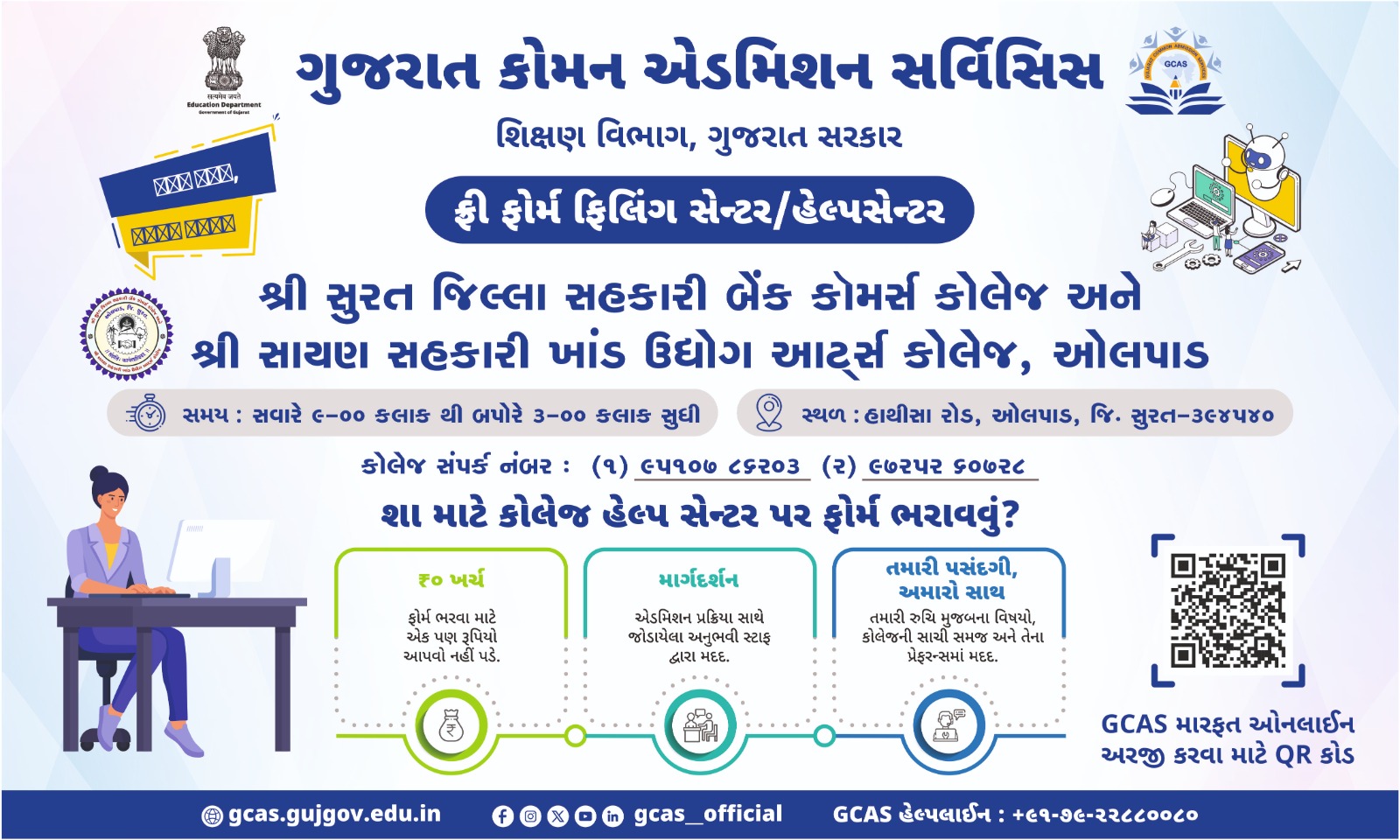
Shri Surat Jilla Sahakari Bank Commerce College and Shri Sayan Sahakari Khand Udhyog Arts College, Olpad—popularly known as Arts & Commerce College, Olpad—is managed by Shri P. K. Desai Kelavani Mandal, Olpad. The college was established in 1991 with an initial enrollment of just 150 students, marking a significant milestone in the region’s pursuit of higher education.
Prior to this, the institution was managed by Azad Din Smarak Kelavani Mandal, a pioneering trust dedicated to promoting education throughout Olpad Taluka. This trust played a vital role in the educational development of the area by establishing secondary and higher secondary schools in various villages, laying the foundation for the advancement of formal education in the region.
Olpad Taluka is strategically located along the saline coastal belt of the Arabian Sea, approximately 20 kilometers northwest of Surat city in Gujarat. This proximity to both the coastline and a major urban center has significantly influenced its historical development, socio-economic structure, and cultural landscape.
The taluka encompasses 112 villages, most of which are predominantly rural and agriculturally driven. A significant portion of the population belongs to socially and economically disadvantaged groups, including Scheduled Castes (SC), Scheduled Tribes (ST), Socially and Educationally Backward Classes (SEBC), Economically Backward Classes (EBC), and Minority communities. Agriculture remains the backbone of the local economy, with many villagers engaged in farming and allied activities, despite the challenges posed by saline soil and limited irrigation facilities.
Historically, Olpad held a place of prominence and was once known as ‘Urpattanskshetra’, a name that reflects its status as a thriving and prosperous center of learning and culture. The region was particularly renowned for being the home of Sanskrit scholars and astrologers, who contributed to its reputation as an intellectual and spiritual hub in South Gujarat. Temples and ancient sites scattered across the taluka still bear testimony to its rich historical past and cultural depth.
Over the decades, the region has evolved, balancing its deep-rooted traditions with the demands of modernity. While agriculture continues to dominate the local economy, recent initiatives in education, renewable energy (such as solar-powered irrigation), and infrastructure development have begun transforming the lives of people in the taluka.
Olpad today stands as a unique blend of heritage and progress, where ancient wisdom coexists with aspirations for a better, more inclusive future.
Prior to this, the institution was managed by Azad Din Smarak Kelavani Mandal, a pioneering trust dedicated to promoting education throughout Olpad Taluka. This trust played a vital role in the educational development of the area by establishing secondary and higher secondary schools in various villages, laying the foundation for the advancement of formal education in the region.
Olpad Taluka is strategically located along the saline coastal belt of the Arabian Sea, approximately 20 kilometers northwest of Surat city in Gujarat. This proximity to both the coastline and a major urban center has significantly influenced its historical development, socio-economic structure, and cultural landscape.
The taluka encompasses 112 villages, most of which are predominantly rural and agriculturally driven. A significant portion of the population belongs to socially and economically disadvantaged groups, including Scheduled Castes (SC), Scheduled Tribes (ST), Socially and Educationally Backward Classes (SEBC), Economically Backward Classes (EBC), and Minority communities. Agriculture remains the backbone of the local economy, with many villagers engaged in farming and allied activities, despite the challenges posed by saline soil and limited irrigation facilities.
Historically, Olpad held a place of prominence and was once known as ‘Urpattanskshetra’, a name that reflects its status as a thriving and prosperous center of learning and culture. The region was particularly renowned for being the home of Sanskrit scholars and astrologers, who contributed to its reputation as an intellectual and spiritual hub in South Gujarat. Temples and ancient sites scattered across the taluka still bear testimony to its rich historical past and cultural depth.
Over the decades, the region has evolved, balancing its deep-rooted traditions with the demands of modernity. While agriculture continues to dominate the local economy, recent initiatives in education, renewable energy (such as solar-powered irrigation), and infrastructure development have begun transforming the lives of people in the taluka.
Olpad today stands as a unique blend of heritage and progress, where ancient wisdom coexists with aspirations for a better, more inclusive future.